Wednesday, May 30, 2012

Artist’s Statement:

   I have long been fascinated with cultures different from my own. Recent trips to Turkey, Italy, Israel and Cyprus opened a window into a marvelous world of which I had only dreamed. Along with thousands of photographs, I brought home with me a love of these places and their people. During my travels, I was reminded once again of the notion that all people are at most six steps away from any other person on earth. This ever-increasing connectedness of human beings can have profound consequences for human societies. 
   As our world shrinks, we are compelled to find ways to live in harmony with our neighbors. Visual art is a powerful vehicle for storytelling as well as for teaching, and this new series was created to tell a story of European and Middle Eastern cultures as I experienced them. In particular, I wanted to portray Islamic culture in the light in which I beheld it. There is an abundance of beauty in the spaces between West and East, and I invite my contemporaries in for a glimpse into this fascinating world.
    This series incorporates digital imaging, paper and fabric collage and acrylic painting techniques. Some pieces incorporate all of these techniques, while others are limited to one or two. One one level, my intention was to create a series of work which expressed my impressions of these countries and their people. On another, this series is also an exploration into the world of collage art. Collage as an art form has a long and rich history, and it has been suggested that it can be understood as a metaphor for human perception. Perception is in essence a cut and paste operation, and the same holds true for consciousness, dreaming and memory. An example is the way in which the human brain, through narrative dreams, makes up a story from bits of experience.
   The principles of collage move easily between two and three dimensions as well as mediums and have been used in literature, internet culture, cinema, philosophy, and music as well as in visual art. Bob Dylan used the collage principle decades ago, and Lucinda Williams utilizes it in her song "Too Cool to be Forgotten, in which she collects examples of graffiti from juke joint bathroom walls and uses them to compose the selection.
   All of the pieces in this series are available for purchase.  Please contact me for price information.

This series of work has been made possible with grants from Greater Jackson Arts Council, Mississippi Arts Commission, and Six Degrees Consortium.
Portal Series

This series of images from various locations have been created in shadow boxes to give a sense of depth to the work. Each piece has two or three layers coming forward from the background. Portal 1-8 are paper collages and 9-16 incorporate other elements including glass, metal, polymer clay, fabric, cowrie shells, gemstones and candles from a shop near the Churchof the Holy Sepulcher in Jerusalem.
Portal 21: Discussion (Jerusalem 2012)  8” x 10” x 2”
Portal 20: Scrolls (Jerusalem 2012)  8” x 10” x 2”

Tuesday, May 29, 2012

Portal 19: The Good Daughter  8” x 10” x 2”
Portal 18: Liturgy  8” x 10” x 2”

Portal 17: Nun  8” x 10” x 2”
Portal 16: Veil  8” x 10” x 2”
Portal 15: Pilgrim  8” x 10” x 2”

Portal 14: The Shopper  8” x 10” x 2”
Portal 13: Priest 2  8’ x 10” x 2”
Portal 12: Holy Sepulcher Priest  8” x 10” x 2”
Portal 11: Cinque Terre 11’ x 14’ x 1”
Portal 10: Duomo, Florence  11” x 14” x 1”
Portal 9: Siena  11” x 14” x 1”
Portal 8: Tuscany  11’ x 14” x 1”
Portal 7: Venice Canals  11” x 14” x 1”
Portal 6: Incense in the Old City  11” x 14” x 1”
Portal 5: Repairing the Nets  11” x 14” x 1"
I came upon these old friends on Burano, an island in the Venetian Lagoon.
Portal 4  Women at the Wall 11" x 14" x 1"


Western Wall 3
This little boy was patiently waiting for his mother while she prayed at the wall. His expression indicates that he understands the solemnity of the visit.
Streets of Jerusalem 8
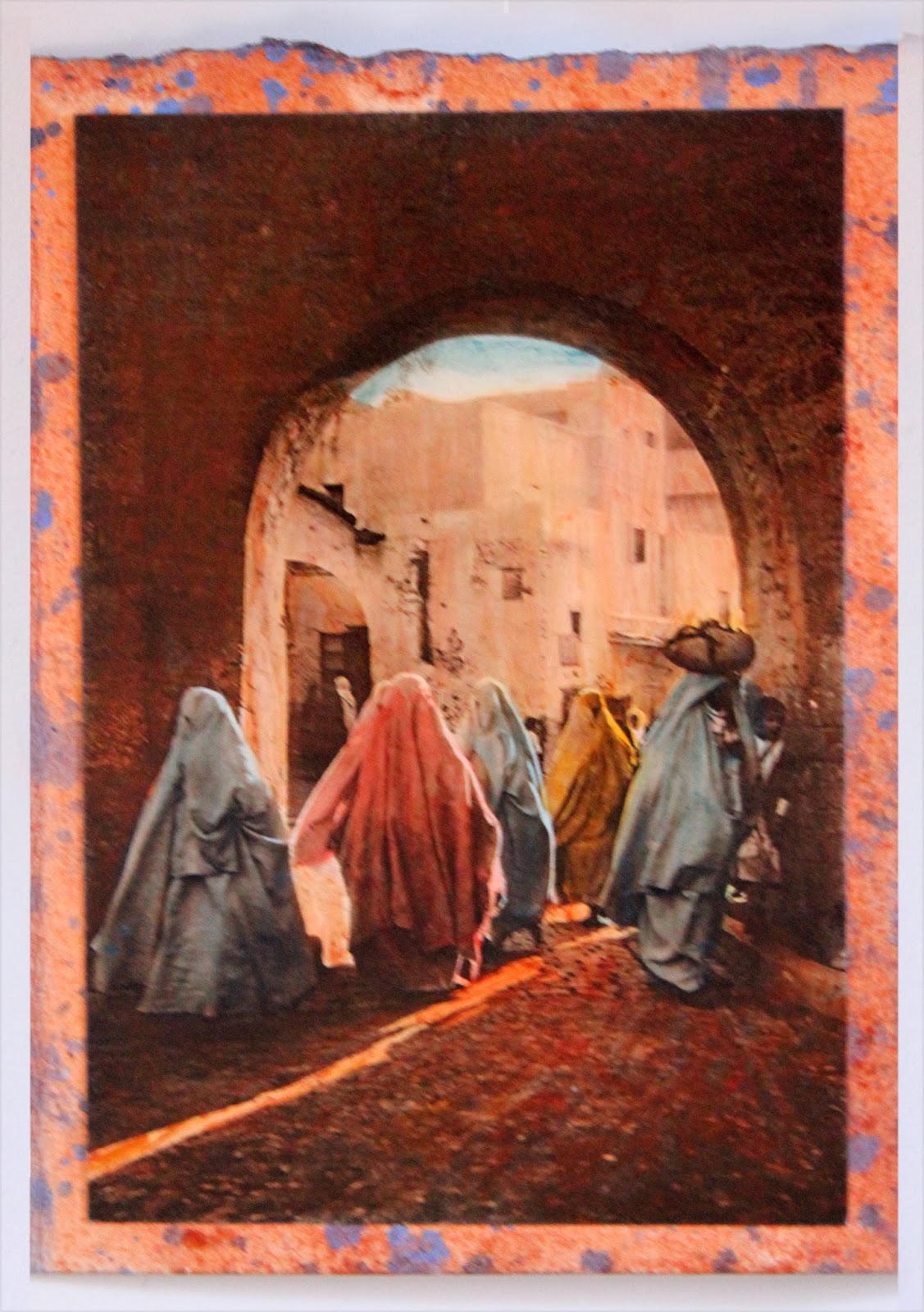
I was walking behind this woman one day on a trip to the Western Wall and was intrigued by the light and the way she was framed in the arched, covered streets of the Old City.

Tuesday, April 10, 2012

The following images are the result of wandering around the streets of Jerusalem for two weeks in January 2012. What a magical time that was...
Bar Mitzvah 1: The Cantor's Song  16" x 20"
I did not need to understand Hebrew to know what this song was about. The poignant expression on the cantor’s face, his body language and the response of the participants all indicated the joyous nature of this event. I placed him directly in front of the Wall, where the prayers of unknown visitors can be seen. In front of him is the sterling silver and gold Torah Case.
Bar Mitzvah 2: A Son's Questions
 In this image, a father is helping his son to don his tefillin. For the rest of his life, the Bar Mitzvah is obligated to wear the tefillin at all appropriate times. These small leather boxes contain scrolls of Torah passages which command Jews to bind the word of God on their bodies. The white tallit (prayer shawl) worn by the father identifies him as belonging to the Sephardic tradition.
Bar Mitzvah 3: Leaving Childhood Behind
In some Jewish traditions, a doll is presented to the Bar Mitzvah as a symbol of the childhood he is leaving behind. This is a more solemn aspect of the ceremony and to accentuate that aspect of a boy becoming a Bar Mitzvah, I placed a man in prayer at the Western Wall.
Bar Mitzvah 5 Father and Son  16" x 20"
In addition to the joyous aspect of the ceremony, there were some very tender moments as well. Here, a father holds his son close, perhaps mourning the loss of his little boy to adulthood.
Bar Mitzvah 4: The Dance  16" x 20"
I wanted to capture the celebratory aspect of the ceremony in this image. The cantor in this scene is singing boisterously, and leading the participants in a dance as well. All of the men were in a circle around the Bar Mitzvah, singing and dancing their hearts out.
Streets of Jerusalem 2  18" x 20"
I do not have a clue where these intriguing men were from, if they were Old City residents or pilgrims. I was fascinated by them as soon as I saw them approaching and managed to get one good shot, and placed them in front of a shop that sold brightly patterned fabric. What a smile that guy in the middle has!
Streets of Jerusalem 1  18" x 20"
I would not make it as a photojournalist, because I am overly sensitive about being intrusive with my camera. This was one of those insatnces when I felt guilty as soon as I took the photo; the man on the left obviously did not want his photo taken. How to tell beforehand?
Western Wall 2  18" x 20"
Many of the men at the Western Wall arrived with book in hand, and spent long periods of time standing facing the wall. I ssaw many women with prayer books as well, although the only lecturns present were on the men’s side.
Streets of Jerusalem 4  16" x 20"
I captured this photo in a bustling souk in the Muslim Quarter. The intense gaze on the woman’s face caught my attention. I placed her in front of a wall that had the remnants od postors with Arabic text.
Streets of Jerusalem 3  16" x 20"
 This woman’s red beret caught my eye from a long distance away. I took several photos as she approached, and made eye contact with her just as she was passing me.
Streets of Jerusalem 6: The Cardo  16" x 20"
The Cardo was a north-south oriented street in Roman cities that was lined with shops and vendors and served as a hub of economic life. Jerusalem’s Cardo was built around 130 CE, and converted to an Arab-style marketplace in the 7th century. In the 1960s remains of the Byzantine Cardo were unearthed in the Jewish Quarter, and excavation began. Today, situated 20 feet below modern street level, one part of the Cardo is a restored arcade of galleries and shops, while the other part is an open-air reconstructed street. This mural depicts Jerusalem life along the Cardo, and I placed several Franciscan monks in front. 
Western Wall 1  16" x 20"
I visited the Wall many times during the course of my stay in Jerusalem; I could not seem to stay away. During most hours of the day, the Wall is a very busy and crowded place. I learned that if I wanted to avoid the crowds, I had to arrive just as it was getting light and even then, it was a challenge to find an individual who was not surrounded by others.
Streets of Jerusalem 5: Merchant 1  16" x 20"
This woman was conducting her business on Al-Wad Road, just inside the Old City walls near the Damascus Gate. Her wares consisted of fresh herbs and vegetables, and she always seemed to be doing a brisk business.
Streets of Jerusalem 7: Damascus Gate 16" x 20"
I captured these two men in conversation at the steps leading down to the Damascus Gate, the main entrance into the Old City. In its current form, the Damascus Gate was built in 1537 under the rule of Suleiman the magnificent, the Sultan of the Ottoman Empire. Underneath, remains of a gate dating to the 2nd century AD have been excavated.
Bar Mitzvah 6: The Torah  18" x 24"
As the primary holy scripture of Judaism. the Torah is revered and treated with the utmost respect. Traditional Torahs are handwritten on scrolls and protected in silver and gold Torah cases. Hinged doors on the cylindrical cases open to reveal the text and here, father and son are gazing upon the scrolls. I noticed that onlookers were constantly reaching out to touch the Torah as it was being paraded past.

Sunday, February 19, 2012

FACES OF HEBRON:
One Day in the West Bank

In January 2012, I spent two weeks in Israel/Palestine thanks to the generosity of the wonderful folks who make up the Six Degrees Consortium. I stayed in a convent in Jerusalem's Old City, just a floor above the busy streets of the Muslim Quarter. My time in the Old City was an incredible experience that I will never forget, and there were many moments of joy and discovery. For one day however, I left the magic of the Old City for a tour of the West Bank city of Hebron. Newspaper and television reports had not prepared me for my insight into the reality of life for Palestinians in the occupied territories. I created this series of collages in an attempt to portray the people of Hebron and their struggle for autonomy. More information on the Israel/Palestine situation may be found on the web at http://apartheidweek.org, and a weekly newsletter by Professor Mazin Qumsiyeh may be accessed at qumisyeh.org.

Lori Gordon
February 19, 2012
 

Saturday, February 18, 2012

In the narrow, twisting streets of Hebron's Old City marketplace, one can see a strange site by looking overhead. Chain link fence and other heavy gauge wire covers the open area between the rooftops on either side of the street. The wire is necessary to protect the shop owners and customers of the markets from refuse. This trash-garbage, broken pieces of furniture, even large chunks of rebar-embedded concrete-has been thrown from the windows of a high rise apartment building that is situated next to the market. The high rise residents are settlers-hardline Zionists whose avowed purpose is to make Israel/Palestine 100% Jewish.

I decided to use portions of the fence in all of the pieces in this series, both as a visual reminder of the actual wire overhead and as a symbolic device to indicate the virtual prison in which the Palestinians of the occupied territories are forced to live. I also wanted to capture the everyday life of these people; a tailor working in the doorway of his shop, two women on an errand, people with a donkey loaded with belongings making their way through a checkpoint.

My methodology consists of several stages. I first designed the collages on my computer and when I had a mock-up of the piece, I printed out sections of the images on 80 lb. Paper. The images were then individually cut out and fitted together in the manner of a jigsaw puzzle, and adhered to the support. The completed pieces were then coated with a satin UV varnish.


All collages are available for sale. Please email me for prices and availability.
Hebron Collage 12

I wanted to point to the length of time involved in the displacement of the Palestinian people by including an image of two different generations. The situation has continued for over 60 years.  The older man was a child when the occupation began, and the young men may live to see Palestine become an autonomous nation. For symbolic reasons, I chose to leave out the third, middle generation of Palestinians whose entire lives have been spent as persons of an occupied country.  
Hebron Collage 11

These two women were walking very purposely  down the street. I placed them in front of a barricaded dead end alley; the only place I saw in the marketplace that did not have the protective fence overhead. The trash thrown down from the settler's high rise is piled up 3-4 feet tall in this area. Amidst the trash and barbed wire I created a symbolic protective "roof line" with words of text from a 2009 report on Israel's human rights violations against Palestinian women. More of the text provides a foundation for their feet but some of it has crumbled to pieces, indicating the fractured nature of the protection human rights watch groups can provide.
Hebron Collage 10

In this collage, I captured a woman approaching a checkpoint for passage to her neighborhood. She is behind a man that has tied his donkey to the fence as he requests that an Israeli soldier open the gate for his animal to pass through. These Israeli checkpoints are everywhere, and while I was allowed to pass through, our guide, a Palestinian activist, was not. I enlarged the physical size of the soldier of soldier before placing him in the guard shack to indicate the David/Goliath nature of the situation at the checkpoints.
Hebron Collage 9

This piece incorporates images from the Ibrahim Mosque in Hebron where in 1994 Baruch Goldstein, an Israeli settler and member of the far-right Israeli Kach movement, opened fire on unarmed Muslims praying inside. Twenty nine Muslims were killed, and one hundred twenty five were injured. The niche made of ceramic tiles provides a place for the Israeli soldiers in this image; half of the mosque has been converted to a synagogue, and on Jewish holy days, Muslims are not allowed to enter their mosque. Spilling out of the niche are a pile of plastic rugs kept in the mosque. These rugs are used to cover the carpets when non-Muslims who refuse to remove their shoes are in the mosque. Our guide told us that Israeli government officials have been guilty of this disrespect, as well as Jewish settlers.
Hebron Collage 8

This woman was actually photographed in the Arab souk just inside the Damascus Gate. Her expression was so poignant that I placed her  in the Hebron marketplace. When the term "apartheid" is used to describe the situation of Palestinians, it not only refers to the West Bank and Gaza, but to the laws regulating the lives of Palestinians living inside what is now called Israel. While Palestinians in Jerusalem have Israeli citizenship unlike those in the West Bank and Gaza, they are still living subject to a different set of law than the Jewish citizens, and are treated as second class citizens. The settlers' high rise can be seen towering over her, and more lines of testimonials of Palestinian women are providing her support.
Hebron Collage 7

This man was sitting in the entrance to his shop. Beside him is a scale that is overflowing with testimonials regarding the Israeli occupation of Palestine. I chose to break up the surface of his coat with fractured images of the marketplace to indicate the shattered lives of so many Palestinians.
Hebron Collage 6

I saw a good number of Jewish people walking in the Old City area of Hebron, and I do not know if they were settlers or not.  I do know that there are Jews worldwide who are aware of the injustice of the occupation and all of its consequences, many of whom are working to correct the injustice, and I would hate to represent someone who was not a hard core Zionist as a settler. Whoever this man is, he is walking in a chaotic wasteland that is packed with symbolism.
Hebron Collage 5

I found this woman resting on a piece of concrete while I went through the checkpoint in the old city area. I felt that her facial expression indicated a weariness and possibly resignation to her experience as a woman living in the  occupied territories. Behind her is the ceramic niche from the mosque, and she is sitting on some concrete blocks that have been spray painted with the message that has spread the world over.
Hebron Collage 4

Palestine can be seen as a study in contrasts, as illustrated by the Israeli jeep and the the boys with their traditional mode of transportation. Both above and below, the chain link fence holds their lives in suspension.
Hebron Collage 3

The symbolism in this piece is obvious; these men are walking forward, out of the wasteland of the occupation on stepping stones to a future that many people worldwide are affecting to change. Israel is a powerful military state with a profound amount of financial support from other nations, including the United States. The call for BDS campaigns (boycott, divestment and sanctions) is becoming a worldwide phenomenon but change is slow to come to Palestine.
Hebron Collage 2

I came upon this tailor in his shop, surrounded by his work and intent upon his efforts. He is suspended in mid air, surrounded on all sides by the presence of the settlers.
Hebron Collage 1

The expression on this young man's face reflects the misery of the occupation, which has profoundly affected several generations of Palestinians. I placed him walking on the top of several pieces of concrete used by the Israelis to block off a street, and which display grafitti in both English and Arabic. All over the world, there is a growing consensus that the Israeli occupation is a land-based apartheid system, and a call for boycott, divestment and sanctions against Israel is gaining popularity daily. Overhead is the screen of wire, and a pile of settler refuse is in the background.

Saturday, December 31, 2011

Istanbul 2
Street Scene


This is typical of the streets I wandered during my stay in Istanbul. A city with many hills dropping down to the shores of the Bosphorus or the Sea of Marmara, breathtaking views are apparent wherever one looks. Many of the city's streets are narrow, with hand-pushed vegetable carts resting beside newer model automobiles.
I found that contrast intriguing, and decided to push the idea of contrast in the composition of this piece. I transformed the foreground into abstract shapes, and let them gradually morph into buildings as they receded into space.  SOLD